Every year, preventable machinery accidents claim lives and injure hundreds—many caused by uncontrolled release of hazardous energy during maintenance. The solution isn’t just training or equipment. It’s a well-constructed lockout tagout written procedure.
Without a documented process, even experienced technicians are vulnerable. A verbal agreement or vague instruction is no match for the deadly force of unexpected startup or residual energy. A formal LOTO procedure isn’t bureaucratic red tape—it’s a life-saving roadmap written in advance, so no guesswork happens under pressure.
This guide breaks down how to build, deploy, and maintain a compliant, practical LOTO written procedure that holds up under real-world conditions.
Why a Written LOTO Procedure Isn’t Optional
OSHA 29 CFR 1910.147 requires employers to develop and enforce a written energy control program. That includes specific written procedures for every machine or system where servicing could expose workers to hazardous energy.
Guessing what needs to be locked out? That’s not a procedure—it’s a risk. A written LOTO process is non-negotiable because:
- It standardizes safety across shifts and personnel
- It meets legal and compliance requirements
- It reduces human error during high-risk tasks
- It serves as a training tool and audit reference
- It protects both employees and the organization in incident investigations
A verbal “just unplug it” approach fails when systems involve multiple energy sources—electrical, hydraulic, pneumatic, thermal, or gravitational. Only documented procedures capture the full scope.
Key Components of a Compliant LOTO Written Procedure
A powerful LOTO procedure isn’t just a checklist. It’s a detailed, machine-specific guide that walks an authorized employee through every step. Each document must include at least these elements:
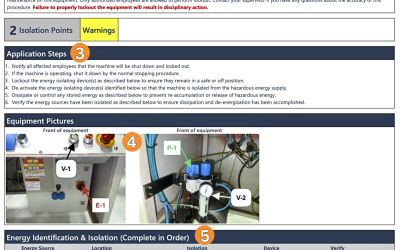
1. Machine or Equipment Identification Clearly state the name, location, and model of the equipment. Use diagrams, photos, or ID tags if needed. Example: “Hydraulic Press Model HP-750, Production Line B, East Facility.”
2. Type and Source of Hazardous Energy List all energy sources powering the equipment. Don’t stop at electricity. Include: - Electrical - Pneumatic (compressed air) - Hydraulic (fluid pressure) - Chemical - Thermal (heat/steam) - Gravitational (elevated parts) - Mechanical (springs, flywheels)
3. Shutdown Sequence Detail the step-by-step process to safely shut down the machine. Include: - Notification of affected employees - Sequence of shutdown (e.g., stop conveyors before pumps) - Use of normal stopping controls
- Example:
- Press emergency stop button.
- Rotate selector switch to “OFF.”
- Confirm all moving parts have stopped.
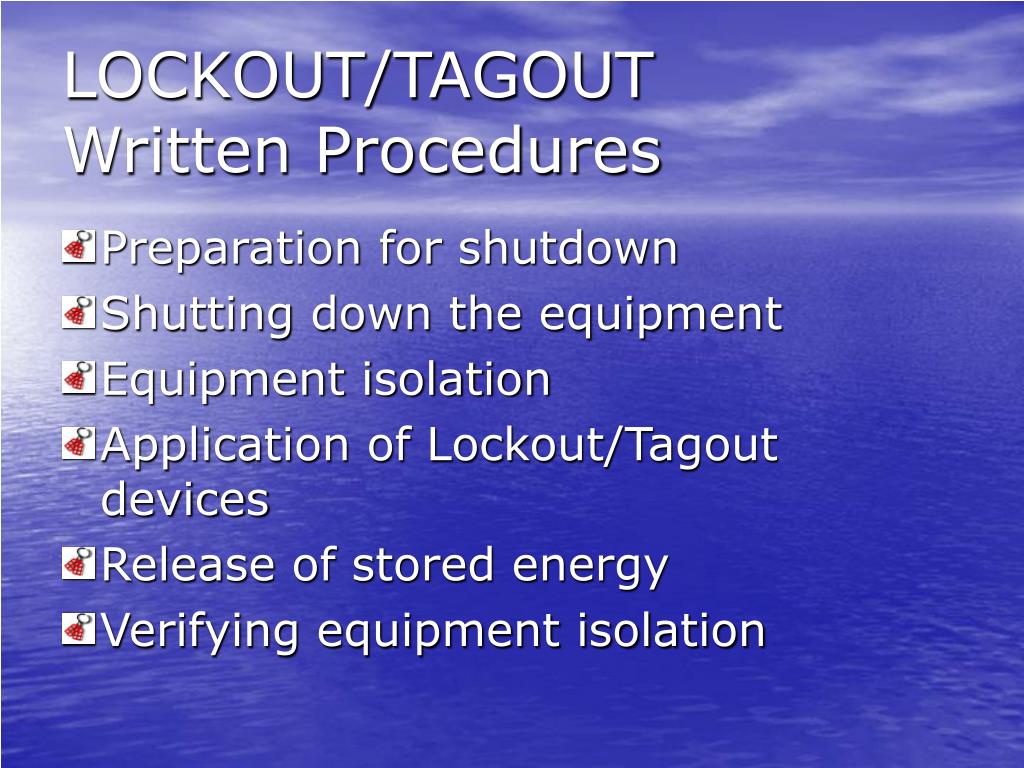
4. Isolation of Energy Sources Specify the exact control points (disconnects, valves, blocks) that must be locked. Be precise: - “Disconnect switch DS-3, located at base of control panel” - “Close and lock isolation valve HV-12 on hydraulic line” - “Depressurize pneumatic lines using manual bleed valve”
5. Application of Lockout/Tagout Devices List who applies locks, what type of devices are used (hasps, lockout brackets), and how tags must be completed (name, department, time, reason).
Each lock must be individual and non-transferable. Group locks are acceptable only with proper protocols.
6. Control of Stored Energy Describe how to safely dissipate or restrain residual energy: - Bleeding hydraulic lines - Blocking elevated parts with safety pins - Discharging capacitors - Cooling hot surfaces
7. Verification of Isolation The most critical step. The procedure must require positive verification that zero energy is present. Example: - Test start button after lockout - Use a voltage tester on circuit - Visually confirm lines are depressurized
This is not a formality. It’s the final checkpoint before work begins.
8. Steps for Restoration Outline how to safely return the machine to service: - Remove tools and guards - Notify all affected employees - Remove locks (only by the person who applied them) - Re-energize in reverse shutdown order - Test operation
Real-World Example: LOTO Procedure for a Conveyor System
Equipment: Main Product Conveyor, Line 3 Energy Sources: Electrical (480V), Mechanical (belt tension), Gravitational (inclined section)
- Notify all affected employees that maintenance will begin.
- Press E-stop on control panel; wait 10 seconds for full stop.
- Open main disconnect switch (DS-301) and visually confirm open.
- Attach personal lock and tag to DS-301.
- Use manual release to slacken belt tension.
- Insert safety pin into incline support to prevent rollback.
- Test start button—no response should occur.
- Begin maintenance.
- After work: remove tools, retract safety pin, ensure clear path.
- Remove lock, close disconnect, restore power.
- Restart using normal controls.
This level of detail eliminates ambiguity. A new technician should be able to follow it without asking questions.
Common Mistakes That Undermine LOTO Procedures
Even companies with written procedures fail because of poor execution. Watch for these pitfalls:
❌ Using Generic Templates Without Customization A one-size-fits-all LOTO form won’t work. Each machine has unique energy sources and isolation points. Tailor every procedure.
❌ Skipping Verification Technicians sometimes assume “if it’s locked, it’s safe.” But misidentified disconnects or stored energy can still kill. Always test.
❌ Allowing Tag-Only Use Without Locks Tags are warnings. Locks are physical barriers. OSHA allows tag-only systems only in limited cases where locks can’t be used—and even then, extra safeguards are required.
❌ Poor Lock Management Shared locks, master keys, or communal lockout stations undermine accountability. Each worker must have their own lock with a unique key.
❌ Infrequent Review and Training LOTO procedures must be inspected annually. Outdated documents create false confidence. Also, retrain employees yearly and whenever procedures change.
How to Write a LOTO Procedure: A Step-by-Step Workflow
Creating a reliable document requires collaboration and field verification. Follow this process:
- Assemble a Team
- Include maintenance leads, safety officers, and operators familiar with the equipment.
- Conduct an Energy Audit
- Identify all energy sources and isolation points. Use multimeters, pressure gauges, and system diagrams.
- Map the Shutdown Sequence
- Walk through the machine’s shutdown in real time. Note each action and its impact.
- Document Isolation Points
- Label and photograph disconnects, valves, and bleed points. Include exact names and locations.
- Draft the Procedure
- Use clear, active language. Avoid technical jargon unless necessary. One step per line.
- Test It in the Field
- Have an authorized employee use the draft during a real maintenance cycle. Observe gaps.
- Review and Approve
- Finalize with safety management and store in an accessible location—digital and physical.
- Train and Implement
- Conduct hands-on training using the procedure. Document attendance.
- Schedule Annual Audits
- Re-evaluate each procedure yearly. Update after equipment modifications.
Tools and Resources for Building LOTO Procedures
While procedures must be customized, templates and tools speed up development and ensure compliance.
| Tool | Purpose | Best For |
|---|---|---|
| OSHA Lockout/Tagout Interactive Training Program | Free compliance guidance | Beginners, small teams |
| BradyLockout.com Procedure Builder | Online LOTO form generator | Companies with multiple machines |
| Lockout Safety Software (e.g., Procius, Accruent) | Digital LOTO workflows, audits, tracking | Large facilities, complex systems |
| MasterLock LOTO Station Kits | Physical lockout devices and tags | On-site implementation |
| ANSI/ASSE Z244.1 Standard | Best practices for energy control | Enhancing beyond OSHA minimums |
These tools don’t replace your written procedures—they support consistency and scalability.
Pitfalls of Digital vs. Paper-Based Procedures
Digital systems offer advantages: real-time updates, audit trails, integration with CMMS. But they come with risks:
- Downtime access: If the network is down, can workers access procedures?
- Device availability: Not every technician has a tablet on the floor.
- Over-reliance on alerts: Automation doesn’t replace verification.
Paper copies, posted near equipment, serve as reliable backups. The best approach is hybrid: digital master documents with printed, laminated quick-reference guides at each machine.
Final Thoughts: Make It Real, Make It Work
A lockout tagout written procedure is only as strong as its weakest link. No amount of documentation matters if it’s ignored, outdated, or too vague to follow.
The goal isn’t compliance—it’s prevention. A well-written LOTO procedure turns risk into routine. It empowers workers to act confidently, knowing every hazard has been addressed.
Start today: pick one high-risk machine. Walk through it with a technician. Write the steps. Test it. Then repeat.
Safety isn’t a document. It’s a culture built on clarity, consistency, and care.
Frequently Asked Questions
What is a lockout tagout written procedure? It’s a formal, documented process that details how to isolate hazardous energy sources during equipment servicing, ensuring worker safety.
Does OSHA require a written LOTO procedure for every machine? Yes. OSHA 1910.147(c)(4) mandates a written procedure for each machine or piece of equipment that requires servicing where hazardous energy could be released.
Can a tag replace a lock in a LOTO procedure? Only in limited cases where a lock cannot be used. OSHA requires tag-only programs to include additional safety measures, such as continuous supervision.
How often should LOTO procedures be reviewed? At least once per year. They must also be updated when equipment changes or after an incident.
Who is responsible for writing LOTO procedures? Employers are responsible. Safety managers, maintenance supervisors, and authorized employees typically collaborate on development.
Can I use a template for LOTO procedures? Templates are helpful for structure, but each procedure must be machine-specific and reflect actual energy sources and isolation methods.
What happens if a LOTO procedure is not followed? Failure can result in serious injury, OSHA fines (up to $15,625 per violation), criminal charges in fatality cases, and long-term liability for the employer.
FAQ
What should you look for in Lockout Tagout Written Procedure: A Complete Guide? Focus on relevance, practical value, and how well the solution matches real user intent.
Is Lockout Tagout Written Procedure: A Complete Guide suitable for beginners? That depends on the workflow, but a clear step-by-step approach usually makes it easier to start.
How do you compare options around Lockout Tagout Written Procedure: A Complete Guide? Compare features, trust signals, limitations, pricing, and ease of implementation.
What mistakes should you avoid? Avoid generic choices, weak validation, and decisions based only on marketing claims.
What is the next best step? Shortlist the most relevant options, validate them quickly, and refine from real-world results.